Content Menu
● 4-Seat vs 6-Seat Golf Carts: Quick Comparison
● Passenger Capacity: Count the Driver Before Choosing
>> When a Four-Seater Makes More Sense
>> When a Six-Seater Earns Its Extra Space
● Dimensions and Maneuverability: Measure the Route, Not Just the Garage
● Seating Layout and Comfort: Four Seats Are Not Always Alike
>> Rear-Facing vs Forward-Facing Seats
>> Passengers and Luggage Need Separate Planning
● Battery Range and Hill Performance: Compare Complete Systems
>> Compare Energy Capacity, Not Amp-Hours Alone
>> Evaluate Hills With the Intended Load
● Purchase Price and Ownership Cost: Compare Like for Like
● Fleet Planning: Calculate Useful Seats per Trip
● Safety and Road Access: Seating Capacity Does Not Establish Compliance
● Can You Convert a Four-Seat Golf Cart Into a Six-Seater?
● A Practical Acceptance Test Before Buying
● Choosing a BorCart Configuration for Your Application
>> Is a four-seat or six-seat golf cart better for a family?
>> Does a six-seat golf cart always have a shorter range?
>> How much longer is a six-seat golf cart?
>> Are six-seat golf carts suitable for hotels?
>> Can a six-seat golf cart carry six adults and luggage?
>> Which configuration is better for commercial buyers?
Choosing between 4-seat vs 6-seat golf carts involves more than finding room for two additional passengers. Seat count affects maneuverability, battery requirements, storage, operating costs, and how efficiently your vehicle serves its daily route.
My starting point is simple: fit matters more than maximum capacity. A four-seater can be the better investment for narrow resort paths or small families. A six-seater becomes more attractive when larger groups regularly travel together.
At Guangzhou BorCart Electric Vehicle Co., Ltd., our 26 years of industry experience inform a practical approach to electric mobility: match the seating layout, powertrain, and customization package to the application—not the other way around.
This guide compares both options for families, hotels, golf facilities, communities, and commercial fleet buyers.
4-Seat vs 6-Seat Golf Carts: Quick Comparison
The following comparison describes general purchasing considerations, not guaranteed specifications for every model.
| Buying factor | 4-seat electric golf cart | 6-seat electric golf cart |
|---|---|---|
| Passenger capacity | Four occupants, including driver | Six occupants, including driver |
| Best-fit applications | Small families, compact properties, light-duty transport | Group transfers, larger families, hospitality fleets |
| Vehicle footprint | Usually shorter | Usually longer |
| Maneuverability | Often easier in restricted spaces | Requires more attention to route clearance |
| Battery selection | Match to load and daily distance | Account for additional occupants and operating demand |
| Purchase cost | Often lower within comparable specifications | Often higher, but equipment differences matter |
| Cargo flexibility | Depends on seat and storage layout | Extra seats do not guarantee additional luggage space |
| Main purchasing risk | Insufficient capacity during busy periods | Paying for capacity that rarely gets used |
Neither configuration automatically wins on comfort, safety, or value. Those outcomes depend on the complete vehicle specification.
Passenger Capacity: Count the Driver Before Choosing
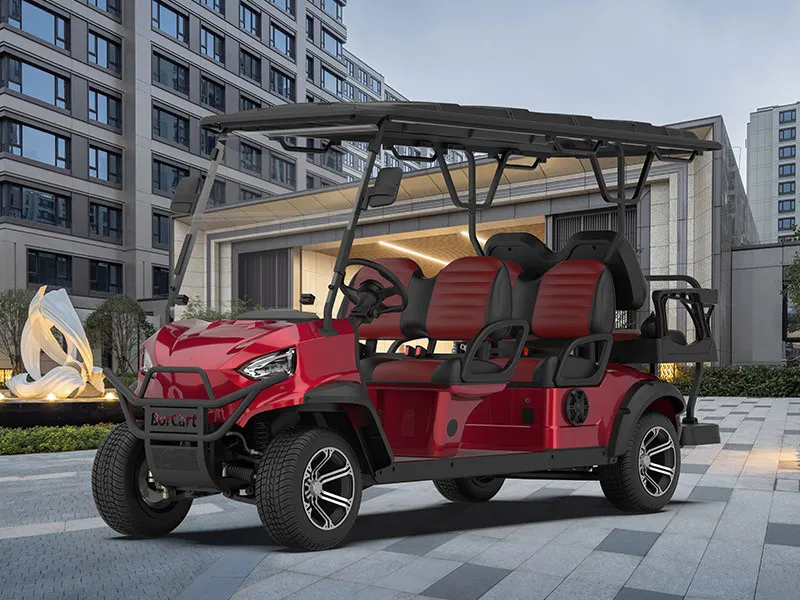
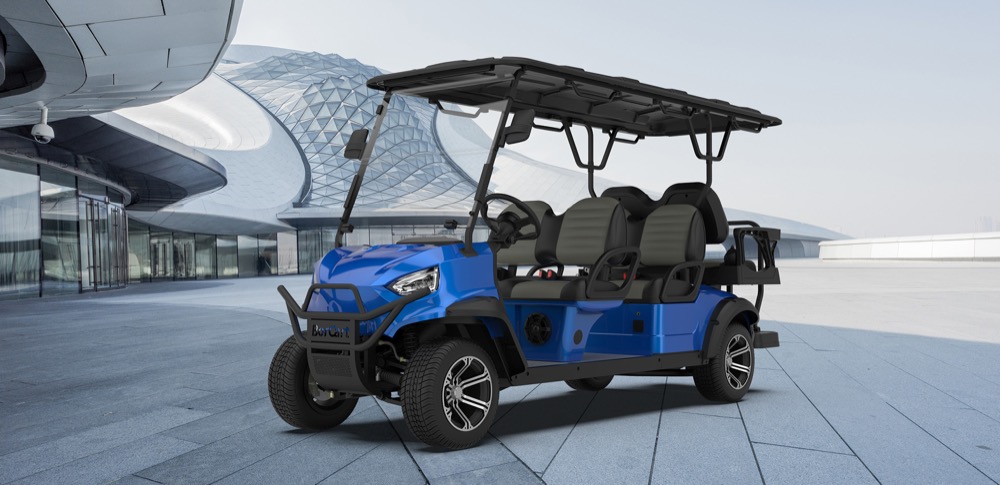
A four-seat golf cart normally accommodates one driver and three passengers. A six-seat model accommodates one driver and five passengers.
That distinction matters for hotels and resorts. “Transporting six guests” requires more than a six-seat vehicle when an employee drives.
When a Four-Seater Makes More Sense
Choose a four-seat electric golf cart when most journeys involve:
- One couple or a small family.
- A driver accompanying up to three guests.
- Security or maintenance staff carrying limited equipment.
- Short trips through narrow paths or compact parking areas.
Occasional overflow does not automatically justify a larger cart. First consider how frequently it happens and whether a second trip is operationally acceptable.
When a Six-Seater Earns Its Extra Space
A six-seat golf cart becomes more compelling when five or six occupants regularly travel together.
Typical applications include family transportation, hotel transfers, community activities, and guided property tours.
However, six available seats do not necessarily mean six adults plus unrestricted luggage. Always check the manufacturer’s rated load and storage arrangement.
Dimensions and Maneuverability: Measure the Route, Not Just the Garage
Seat count alone cannot tell you whether a cart fits your property.
For a concrete example, published non-lifted Club Car Onward specifications list:
| Dimension | Four-passenger model | Six-passenger model |
|---|---|---|
| Overall length | 108 inches / 274.3 cm | 143 inches / 363.2 cm |
| Overall width | 48.75 inches / 123.8 cm | 48.8 inches / 123.8 cm |
| Wheelbase | 65.5 inches / 166.4 cm | 102 inches / 259.0 cm |
In this comparison, length changes substantially while width remains almost identical. These figures illustrate one model family; they are not BorCart specifications or universal industry dimensions.
Before ordering, measure:
- Garage depth and entrance height.
- The narrowest access gate.
- The tightest corner on the intended route.
- Passenger loading and unloading areas.
- Charger access and maintenance clearance.
Request the exact turning-circle specification and a vehicle drawing. A cart that fits through a gate may still struggle to turn immediately afterward.
Seating Layout and Comfort: Four Seats Are Not Always Alike
Rear-Facing vs Forward-Facing Seats
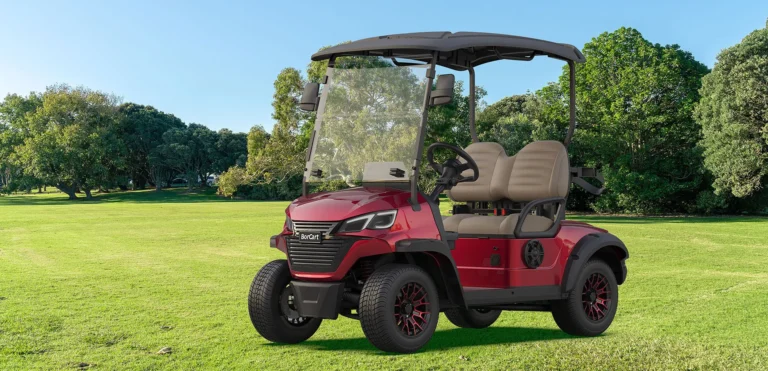
Four-seat carts may use a two-forward, two-rear-facing arrangement or an all-forward-facing layout. Six-seat vehicles also vary.
Compare the actual seating plan rather than relying on passenger capacity alone.
During evaluation, check:
- Legroom in every row.
- Seat cushion support.
- Handhold placement.
- Foot platform dimensions.
- Roof coverage.
- Ease of entry and exit.
For older guests or passengers with restricted mobility, a lower step and convenient handholds may matter more than entertainment features.
Passengers and Luggage Need Separate Planning
A fully occupied cart may leave little suitable space for suitcases, golf bags, or tools.
For airport-style hotel transfers, compare the entire transport task: guests, driver, luggage, and loading time. A utility or shuttle configuration may suit the operation better than a recreational golf cart.
For actual golf use, confirm how bags are secured without obstructing passengers or exceeding load limits.
Battery Range and Hill Performance: Compare Complete Systems
A six-seat golf cart does not automatically have worse range. A larger battery may offset additional vehicle and passenger weight.
Likewise, two carts with identical advertised battery capacity may perform differently because of tires, speed settings, terrain, temperature, and loading.
Compare Energy Capacity, Not Amp-Hours Alone
Amp-hours describe battery charge capacity, but voltage matters too.
For example:
- A nominal 48V, 100Ah battery stores approximately 4.8 kWh.
- A nominal 72V, 100Ah battery stores approximately 7.2 kWh.
These are nominal energy calculations, not usable-energy guarantees or range predictions.
Ask suppliers to state battery voltage, nominal energy, usable energy where available, charger specifications, and the conditions behind advertised range.
Evaluate Hills With the Intended Load
Peak motor power is not enough to establish hill-climbing capability.
Request information about:
- Continuous motor output.
- Controller limits.
- Permitted gradient under a defined load.
- Braking and parking performance.
- Thermal protection during repeated operation.
For a hilly resort, a loaded route demonstration is more informative than an unloaded acceleration video.
Purchase Price and Ownership Cost: Compare Like for Like
Four-seaters often cost less than comparable six-seaters, but a universal price premium would be misleading.
Battery chemistry, chassis construction, suspension, braking equipment, accessories, and destination requirements can change the quotation substantially.
For commercial purchasing, compare:
| Cost category | What to verify |
|---|---|
| Vehicle | Identical specification basis |
| Delivery | Freight, duties, and local handling |
| Charging | Charger compatibility and installation needs |
| Maintenance | Scheduled work and replacement components |
| Battery | Warranty conditions and replacement availability |
| Downtime | Service response and spare-parts lead times |
My preferred purchasing question is not “Which cart is cheaper?” It is “Which configuration completes our required work at the lowest acceptable lifecycle cost?”
A low purchase price becomes less attractive if insufficient capacity creates repeated trips or unavailable parts interrupt service.
Fleet Planning: Calculate Useful Seats per Trip
This simple capacity exercise offers more insight than comparing seat counts alone.
Consider an illustrative hotel operation moving 30 guests along one route, with an employee driving each vehicle.
- A four-seater provides three guest places: 10 fully occupied departures.
- A six-seater provides five guest places: six fully occupied departures.
Under these assumptions, the six-seater requires 40% fewer departures.
This is a planning calculation, not a measured customer result. It assumes all guest places are usable and excludes luggage limitations, arrival patterns, return journeys, and loading delays.
The lesson is not that six-seaters always reduce operating costs by 40%. It is that useful passenger capacity can materially change the workload.
For mixed demand, consider assigning smaller carts to on-demand trips and larger vehicles to scheduled group transfers.
Safety and Road Access: Seating Capacity Does Not Establish Compliance
Four-seat and six-seat golf carts are not automatically approved for public-road use.
In the United States, federal low-speed vehicle requirements include a maximum tested speed of 25 mph and specified equipment such as lighting, mirrors, a parking brake, compliant glazing, a vehicle identification number, and seat belts at designated seating positions. Rear visibility and alert-sound requirements also apply.
Federal vehicle requirements do not, by themselves, establish permission to use every road. State and local rules, registration, insurance, and permitted routes require separate verification.
For other markets, obtain destination-specific advice before finalizing an order.
On private property, establish operating rules covering speed, passenger loading, pedestrian interaction, parking, and driver training. Accessories alone cannot replace an appropriate vehicle specification or responsible operation.
Can You Convert a Four-Seat Golf Cart Into a Six-Seater?
Sometimes, but adding seats is not a complete engineering solution.
Many four-seat carts already use their rear platform for two passengers. A standard rear-seat kit therefore does not automatically create capacity for another row.
A proposed conversion needs assessment of:
- Chassis structure and mounting points.
- Axle and suspension ratings.
- Braking capability.
- Tire load ratings.
- Passenger foot space and restraints.
- Manufacturer approval and warranty implications.
For regular six-person use, compare a factory-designed six-seater against the full cost and limitations of a professionally assessed conversion.
Do not assume additional seating increases the vehicle’s permitted payload.
A Practical Acceptance Test Before Buying
Before placing a fleet order, agree on a repeatable demonstration.
- Define the route, including slopes and tight turns.
- Record the expected passenger and luggage load.
- Confirm tire pressures and starting battery charge.
- Operate at the intended service speed.
- Check access, ride comfort, braking, and parking.
- Record distance, operating time, and remaining charge.
- Verify that the vehicle can recharge within your available window.
Conduct tests in a controlled environment with qualified personnel and within manufacturer limits.
For procurement teams, this process creates an acceptance standard that can be attached to the purchase specification. It also helps identify problems before vehicles enter daily service.
Choosing a BorCart Configuration for Your Application
BorCart’s product range includes electric golf carts, sightseeing vehicles, cargo vehicles, patrol vehicles, and multipurpose utility vehicles.
That wider choice matters. A passenger cart is not always the best answer for farm tools, maintenance equipment, or frequent luggage transport.
For OEM/ODM projects, discuss seating configuration, branding, body colors, battery options, and application-specific equipment. Ask the team to confirm which combinations are available for the selected platform.
Send BorCart your passenger requirement, daily distance, maximum route gradient, luggage needs, destination market, and order quantity. Request matched four-seat and six-seat proposals with clear specifications, warranty terms, spare-parts support, and acceptance criteria.
Frequently Asked Questions
Is a four-seat or six-seat golf cart better for a family?
A four-seater suits households that normally travel with four or fewer occupants. A six-seater is more practical when larger groups regularly ride together, provided storage space, payload, and route access are suitable.
Does a six-seat golf cart always have a shorter range?
No. Range depends on battery energy, vehicle configuration, load, terrain, and operating conditions. Compare equivalent test conditions rather than assuming seat count determines distance per charge.
How much longer is a six-seat golf cart?
It varies by platform. In the non-lifted Onward example above, the six-passenger model is 35 inches longer. Obtain current drawings for the exact models you intend to purchase.
Are six-seat golf carts suitable for hotels?
They can suit group transfers, but the driver occupies one seat. Check guest capacity, luggage storage, boarding access, route clearance, and charging arrangements before choosing.
Can a six-seat golf cart carry six adults and luggage?
Only when the combined load and storage arrangement remain within manufacturer limits. Seating capacity is not a guarantee that every passenger-and-luggage combination is acceptable.
Which configuration is better for commercial buyers?
Choose according to recorded demand. Four-seaters can suit smaller parties and restricted routes; six-seaters can reduce departures when larger groups travel together. Mixed fleets may handle varied demand more effectively.
References
1. The Cart Finder — “4-Seat vs. 6-Seat Golf Carts: Choosing the Right Passenger Capacity”. Competitive topic reference; its generalized pricing, conversion, and road-use statements are not adopted as universal specifications.
2. Club Car — Onward 4 Passenger Specifications and Dimensions. Source for the four-passenger dimensional example and seating arrangement.
3. Club Car — Onward 6 Passenger Specifications and Dimensions. Source for the six-passenger dimensional example.
4. Electronic Code of Federal Regulations — 49 CFR § 571.500, Standard No. 500: Low-Speed Vehicles. Primary regulatory source for the U.S. federal equipment and maximum-speed discussion.
5. BorCart — Manufacturer Website. Source for the company’s electric-vehicle product categories and manufacturing positioning.
6. BorCart — Six-Seat Golf Carts. Source for six-seat product availability and OEM/ODM positioning. The 26-year experience statement follows the company background supplied for this article.
7. BorCart — OEM Golf Carts for Dealers, Wholesalers, and Custom Brands. Source for published customization options. Buying recommendations and illustrative calculations are editorial analysis, not reported field-test results.
Hot Tags: 4-Seater Electric Golf Cart, 6-Seater Electric Golf Cart, Electric Golf Cart Manufacturer, Golf Cart Supplier, Wholesale Golf Carts, OEM Golf Carts, ODM Golf Carts, Custom Electric Golf Carts, Commercial Electric Golf Carts, Resort Golf Carts