EA Carts vs Denago is not simply a contest between higher voltage and a lower purchase price. The better electric golf cart depends on passenger layout, equipment, service access, warranty conditions, and the work you expect it to perform. Both brands deserve consideration, but their published specifications reveal differences that broad marketing comparisons can overlook.
At Guangzhou BorCart Electric Vehicle Co., Ltd., our perspective comes from 26 years in four-wheel low-speed electric vehicle development, manufacturing, and customization. We approach this comparison as a vehicle manufacturer—not as an owner claiming to have independently road-tested either brand.
Our assessment uses publicly available product information reviewed in November 2026. Prices, configurations, and coverage can change. Before buying, request a written quotation for the exact vehicle you will receive.
EA Carts vs Denago: Which Brand Fits Your Priorities?
My starting recommendation is straightforward: shortlist Denago for its advertised entry pricing, published Rover XL specifications, and dealer-based purchasing experience. Shortlist EA Carts for its documented equipment packages, convertible rear seating, and configurations such as the EA4R+.
Neither brand automatically wins on long-term value. EA’s battery replacement program has an important monetary limit, while Denago’s advertised warranty durations still require examination of the full contract.
For commercial buyers, the decision should go further. A resort shuttle, agricultural support vehicle, and neighborhood family cart have different operating requirements.
Quick Comparison of Representative Four-Seat Models
| Buying factor | EA Carts EA4R+ | Denago Rover XL |
|---|---|---|
| Published reference price | $14,498 before tax and delivery | $10,995 in Denago’s published promotional material; confirm locally |
| Seating | Two forward-facing and two rear-facing seats | Marketed as a true four-seater |
| Battery | 60V, 150Ah lithium-ion | 51.2V, 105Ah LiFePO₄ |
| Motor listing | 5 kW AC | 5 kW/6.3 kW AC |
| Advertised range | Approximately 40–45 miles | 40+ miles |
| Published charging time | 7–9 hours | 5 hours |
| Brakes | Front disc, rear hub | Four-wheel disc |
| Battery coverage headline | Lifetime replacement program, subject to conditions | Eight-year advertised warranty |
| Other coverage | One-year eligible-parts warranty; labor excluded | Two years on other major parts and components |
| Purchase and support | Direct purchasing and coordinated repair support | Authorized dealer network |
These are manufacturer-published figures, not results from a shared independent test.
EA Carts vs Denago Pricing: Compare Delivered Vehicles
The EA4R+ lists at $14,498, while Denago has promoted the Rover XL at $10,995. That creates a $3,503 difference before delivery, taxes, configuration changes, and other applicable charges.
However, those vehicles do not offer identical seating arrangements. Buyers wanting four forward-facing seats should compare Denago’s Rover XL with an appropriately configured EA alternative, rather than treating every four-passenger cart as interchangeable.
Build an Apples-to-Apples Quotation
Ask both sellers to itemize:
- Vehicle model and production specification.
- Battery capacity and charger.
- Seating direction and cargo conversion.
- Windshield, mirrors, belts, lighting, and roof.
- Tires, suspension, and braking equipment.
- Delivery, preparation, and registration-related charges.
- Warranty upgrades and service transportation.
The EA4R+ page explicitly includes a lift kit, lighting, mirrors, windshield, seat belts, and wired speakers. Denago’s Rover XL page lists smartphone integration, four-wheel disc brakes, and independent front and rear suspension.
Do not add hypothetical accessory charges to one brand without checking its actual standard equipment. A written build sheet is more useful than a generic “fully loaded” label.
Battery Comparison: Why Voltage Alone Does Not Decide Performance
EA’s 60V system and Denago’s 51.2V system attract attention, but voltage is only one part of an electric drivetrain.
From a manufacturing perspective, I would evaluate battery energy, controller limits, motor characteristics, gearing, vehicle mass, and thermal management together.
A higher voltage specification alone does not prove greater wheel torque, better hill climbing, or lower energy consumption.
Compare Battery Energy, Not Just Voltage
Using the published voltage and amp-hour figures:
| Model | Published battery specification | Calculated nominal energy |
|---|---|---|
| EA4R+ | 60V × 150Ah | Approximately 9.0 kWh |
| Rover XL | 51.2V × 105Ah | Approximately 5.38 kWh |
These calculations describe nominal energy. They do not establish usable capacity, independently measured range, or battery efficiency.
Interestingly, both brands advertise broadly similar driving ranges despite different nominal capacities. That is a reason to request test conditions—not evidence that either manufacturer’s claim is false.
Passenger weight, speed, tire selection, gradients, temperature, and battery reserve settings can materially affect the comparison.
LiFePO₄ Is Also Lithium-Ion
Denago identifies its battery chemistry as lithium iron phosphate, commonly abbreviated LFP or LiFePO₄.
EA describes the EA4R+ battery as lithium-ion. That wording alone does not identify its precise chemistry.
Consequently, a comparison should not present “LiFePO₄ versus lithium-ion” as two mutually exclusive technologies, or assume EA uses a particular chemistry without documentation.
Ask for the battery specification sheet, operating temperature limits, replacement price, and applicable transport and safety documentation.
Warranty Comparison: Read Beyond “Lifetime” and “Eight Years”
Warranty language is one of the most consequential differences in this EA Carts vs Denago comparison.
EA’s product page states that its Lifetime Key & Battery Replacement Program applies while the original purchaser owns the cart, with $2,500 in total battery replacement coverage. Pre-authorization is required, and coverage is non-transferable.
That is not the same as unlimited battery replacement.
EA Carts: Separate the Program From the Factory Warranty
EA publishes:
- One year of coverage on eligible factory parts.
- No labor coverage under the standard factory warranty.
- Optional three-, five-, and seven-year parts-and-labor plans.
- A separate lifetime battery replacement program with stated limits.
A buyer should compare the program’s maximum payment with the installed replacement cost of the specific battery.
Denago: Confirm the Detailed Conditions
Denago advertises lifetime chassis coverage, eight years on its LiFePO₄ battery, and two years on other major parts and components.
Those durations are useful, but they do not answer every ownership question.
Request clarification about capacity-loss thresholds, labor, diagnostic charges, transport, transferability, exclusions, and commercial use. Do not assume either brand’s consumer coverage automatically applies to rental fleets or intensive resort operations.
An expired warranty also does not mean a battery immediately needs replacing. Replacement timing depends on condition and service requirements.
Ride Quality, Braking, and Practical Usability
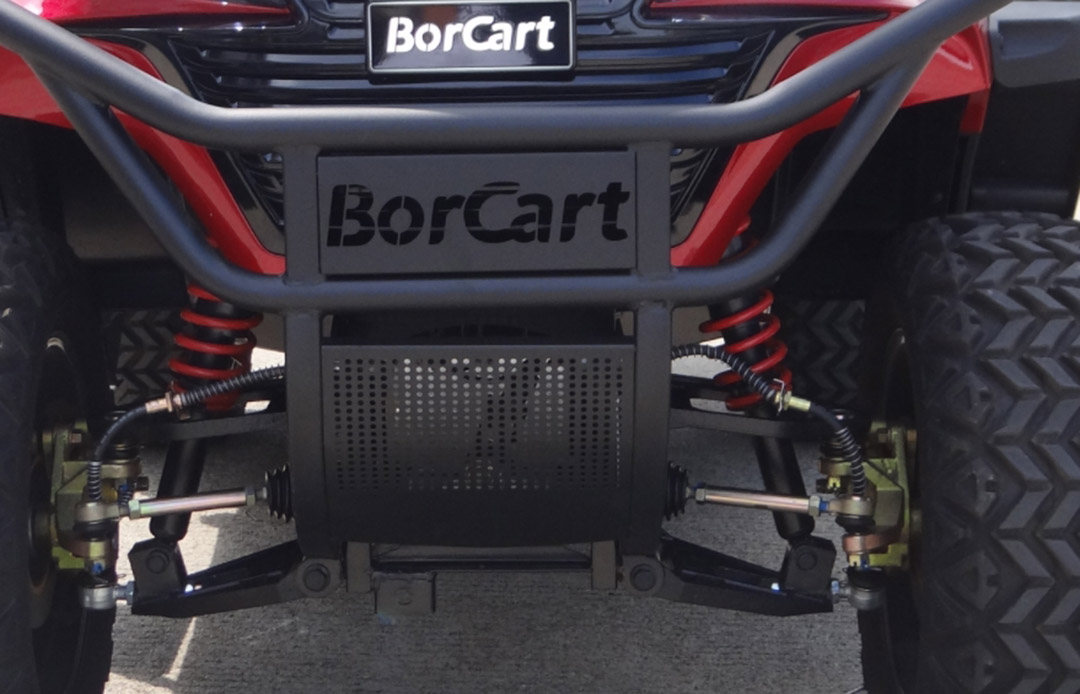
The Rover XL lists four-wheel disc brakes and independent front and rear suspension. The EA4R+ lists front disc and rear hub brakes, plus a lifted suspension package.
These are meaningful design differences, but specifications alone cannot establish stopping distance or passenger comfort.
For a hotel or residential community, evaluate more than appearance:
- Can older passengers enter and exit comfortably?
- Does the vehicle fit under parking structures?
- Can passengers communicate without excessive vibration or noise?
- Is rear visibility adequate when luggage is loaded?
- Does the parking brake hold on the intended parking gradient?
The EA4R+ lists an 81-inch height. That detail may matter more than an entertainment upgrade if the cart must fit through a restricted garage opening.
Dealer Support vs Direct Purchasing
Denago’s authorized dealers can provide a local purchasing and service contact. Actual service capabilities, appointment availability, and parts inventory still vary by dealer.
EA describes a support arrangement in which covered parts can be shipped to the customer, a chosen repair facility, or the technician performing the work. Under its standard warranty, repair labor remains the customer’s responsibility.
Neither arrangement is inherently better everywhere.
My preference for a commercial fleet would depend on documented repair turnaround and local technical capability. For a private owner, proximity to a reliable technician may outweigh differences in dashboard features.
Ask who performs diagnostics, who authorizes repairs, and who pays transportation costs before a breakdown occurs.
A Better Five-Year Ownership Cost Comparison
A useful total ownership cost model includes more than purchase price and electricity:
Delivered purchase cost + charging + scheduled maintenance + uncovered repairs + insurance and registration + downtime − resale value.
Avoid assuming future repair bills will be zero simply because a warranty exists.
Use This Procurement Worksheet
| Cost category | Information to request |
|---|---|
| Delivered vehicle | Signed quotation with all required equipment |
| Charging | Energy measured at the wall during representative use |
| Maintenance | Schedule, consumables, and local labor rates |
| Battery risk | Installed replacement price and contractual coverage |
| Downtime | Repair lead time and temporary replacement options |
| Resale | Comparable local listings and transferability of coverage |
For a hotel, downtime may mean missed guest transfers. For an agricultural operator, it may interrupt scheduled work.
A slightly cheaper cart can become more expensive if it cannot perform its daily route or remain serviceable locally.
A Practical Test-Drive Protocol for Serious Buyers
A structured demonstration provides more useful evidence than comparing voltage labels.
Use the same route and broadly similar operating conditions for each vehicle.
- Load the intended passenger count without exceeding rated limits.
- Include representative inclines, turns, and parking areas.
- Record starting and ending battery charge.
- Evaluate controlled braking in a safe, authorized location.
- Check visibility, entry height, turning clearance, and luggage space.
- Ask a qualified technician to review service access.
- Record configuration details so the delivered vehicle matches the demonstration.
For fleet orders, make agreed acceptance criteria part of the purchase documentation. Define the required route, load, operating duration, and charging window before discussing cosmetic options.
Commercial Applications: When Customization Matters More
EA Carts and Denago both market vehicles for uses beyond a traditional golf round. Denago’s current product directory also extends beyond the three models described in some comparison articles, including additional passenger and utility offerings.
Therefore, buyers should not assume an older lineup summary remains complete.
For resorts, campuses, security teams, and farms, start with the job:
- Resorts need practical boarding and luggage accommodation.
- Patrol teams need visibility and equipment storage.
- Maintenance crews need rated cargo capability.
- Agricultural users need terrain suitability and service access.
At BorCart, our manufacturing focus includes golf carts, sightseeing buses, electric cargo vehicles, patrol vehicles, and multipurpose work vehicles. OEM/ODM discussions should translate these duties into an agreed specification—not simply add branding to a standard passenger cart.
Road Use: Equipment Does Not Guarantee Permission
A vehicle described as “LSV-ready” is not automatically permitted on every public road.
U.S. federal low-speed vehicle classification includes four-wheel vehicles capable of more than 20 mph but no more than 25 mph, subject to additional requirements. Federal equipment compliance and local operating permission are separate issues.
EA’s product page asks buyers to request its LSV package and describes associated documentation.
For either brand, verify the exact vehicle’s certification, identification documents, title eligibility, insurance requirements, and permitted routes with the relevant authorities before purchase.
Final Verdict: Which Electric Golf Cart Should You Choose?
Choose Denago when its available configuration, delivered price, and local dealer support best match your requirements.
Choose EA Carts when its documented equipment package, seating flexibility, and support arrangements justify the quotation you receive.
For commercial procurement, neither badge replaces a route assessment, written specification, and service plan.
To explore a purpose-built alternative, send Guangzhou BorCart Electric Vehicle Co., Ltd. your passenger or cargo requirements, daily distance, terrain, destination market, order quantity, and branding needs. Request an OEM/ODM proposal covering configuration, documentation, spare parts, warranty scope, and delivery terms.
Frequently Asked Questions
Is EA Carts cheaper than Denago?
Not at the representative published prices compared here. The EA4R+ lists above Denago’s promoted Rover XL price. Compare current delivered quotations because equipment, seating, and local charges differ.
Does a 60V golf cart always outperform a 51.2V model?
No. Performance also depends on motor output, controller settings, gearing, weight, traction, and thermal limits. A loaded demonstration is more informative than voltage alone.
Does EA Carts offer unlimited lifetime battery replacement?
Its published program specifies up to $2,500 in total replacement cost, original-owner eligibility, pre-authorization, and other conditions. Review the full agreement before purchase.
What battery warranty does Denago advertise?
Denago advertises eight years for its LiFePO₄ battery. Buyers should confirm the applicable contract, exclusions, capacity provisions, and commercial-use eligibility.
Which brand is better for hotels or resorts?
The better choice is the configuration that meets boarding, luggage, route, charging, and service requirements. Neither brand is automatically superior for every property.
Are EA Carts and Denago street legal everywhere?
No. Eligibility depends on the specific vehicle, its documentation and equipment, and the rules governing registration and operation in the intended location.
References
1. EA Carts — EA Carts vs Denago: Price, Specifications, and Warranty Comparison. Brand-authored comparison used for context, not treated as independent testing.
2. EA Carts — EA4R+ 60V Product Specifications. Source for price, seating, battery, motor, equipment, brakes, dimensions, charging, delivery, warranty limits, and LSV-package statements.
3. Denago EV — Rover XL. Source for battery, motor listing, advertised range, charging time, brakes, suspension, and warranty headlines.
4. Denago EV — Drive More. Pay Less.. Published promotional pricing and dealer-purchasing context; current quotations may differ.
5. Denago EV — Product Directory. Source for the current advertised model range, including passenger and utility vehicles.
6. NHTSA — Laboratory Test Procedure for FMVSS No. 500. Source for federal low-speed vehicle classification and equipment-testing context.
7. NHTSA — Interpretation: Wagar. Source explaining the distinction between federal vehicle requirements and state operating rules.
Hot Tags: Electric Golf Cart Manufacturer, Wholesale Electric Golf Carts, OEM Golf Cart Manufacturer, ODM Electric Golf Carts, Custom Electric Golf Carts, Commercial Electric Vehicles, Low-Speed Electric Vehicles, Lithium Battery Golf Carts, Resort Electric Vehicles, Electric Utility Vehicles