

Content Menu
● Why a Pre-Delivery Golf Cart Inspection Matters
● 1. Define Electric Golf Cart Quality Before Production
● 2. Inspect Bodywork, Chassis, and Component Fit
>> Check More Than Paint Quality
>> Trial-Fit Seats and Accessories Before Packing
● 3. Check the Battery, Charger, and Electrical Installation
>> Confirm Battery Identity and Compatibility
>> Demonstrate a Complete Charging Cycle
● 4. Test Every Light, Display, and Accessory
● 5. Inspect Steering, Suspension, Wheels, and Brakes
>> Steering and Wheel Alignment
>> Braking and Parking-Brake Performance
● 6. Conduct a Controlled Golf Cart Road Test
● 7. Use a Three-Gate Inspection for Partially Disassembled Shipments
>> Gate One: Complete Assembly
>> Gate Two: Transport Preparation
>> Gate Three: Arrival Reassembly
● 8. Turn Defects Into a Clear Shipment Decision
● 9. Verify Documents, Spare Parts, and Packing
● Plan Your BorCart Inspection Before You Order
>> 1. What is the most important electric golf cart quality check?
>> 2. Can I inspect a golf cart remotely?
>> 3. Should rear seats be installed before delivery?
>> 4. Does a fully charged battery prove good quality?
>> 5. What should happen if the cart fails inspection?
>> 6. Should I inspect the cart again after arrival?
To check electric golf cart quality before delivery, inspect the exact vehicle you will receive—not just a showroom sample. Verify its specifications, component fit, battery system, electrical functions, steering, brakes, and driving performance. Then require documented corrections before authorizing shipment.
A polished body and comfortable seats cannot reveal loose suspension hardware, an incompatible charger, or a rear seat that needs drilling before installation. These problems become significantly harder to resolve after an international shipment.
At Guangzhou BorCart Electric Vehicle Co., Ltd., our focus spans electric golf carts, sightseeing buses, cargo vehicles, patrol vehicles, and customized utility models. Drawing on our 26-year manufacturing background, our buyer-side principle is straightforward: verify the finished configuration, not merely the product description.
This electric golf cart inspection checklist turns that principle into practical purchasing steps.

Why a Pre-Delivery Golf Cart Inspection Matters
The customer review supplied with this brief describes several costly frustrations: nonworking headlights, a partially functioning display, an inoperative speedometer, poorly fitting rear seats, wheel alignment concerns, incompatible front-seat brackets, and unavailable replacement parts.
These are allegations from one customer review, not independently verified findings about a particular manufacturer. Nevertheless, they highlight an important purchasing risk: a vehicle may arrive looking complete while still requiring substantial troubleshooting and rework.
A useful inspection therefore addresses three questions:
- Does the vehicle match the approved order?
- Can every supplied component function and fit correctly?
- Can the supplier support repairs after delivery?
For commercial buyers, a low purchase price offers little protection if carts cannot enter service.
1. Define Electric Golf Cart Quality Before Production
Inspection becomes subjective when the purchase agreement says only “high quality” or “standard configuration.”
Create a signed specification sheet before production. For OEM/ODM orders, attach approved drawings, photographs, and a configuration revision number.
| Inspection category | What the order should define |
|---|---|
| Vehicle configuration | Model, seating layout, dimensions, color, and accessories |
| Power system | Motor rating, controller model, battery chemistry, voltage, and capacity |
| Operating requirements | Rated payload, intended terrain, and agreed performance conditions |
| Mechanical assembly | Seat arrangement, suspension, wheels, tires, and braking system |
| Electrical equipment | Lights, display, horn, indicators, and optional accessories |
| Delivery scope | Fully assembled or partially disassembled, tools, manuals, and spare parts |
Avoid ambiguous performance promises. A claimed driving range is meaningful only when its test conditions are stated, including payload, route, speed, tire pressure, temperature, and battery condition.
For customized vehicles, approve one reference unit before releasing the remaining batch.
2. Inspect Bodywork, Chassis, and Component Fit
Check More Than Paint Quality
Inspect the vehicle in good lighting, including underneath and inside accessible compartments.
Look for:
- Cracked panels, sharp edges, exposed metal, and inconsistent panel gaps.
- Visible weld cracks, corrosion, distorted brackets, and damaged mounting points.
- Loose roof supports, windshield mounts, mirrors, and handrails.
- Wiring or hoses contacting moving parts or sharp edges.
- Missing fasteners or hardware that differs from the approved design.
Visual inspection cannot prove weld strength or internal structural integrity. Questionable structural work requires qualified assessment and appropriate manufacturing records.
Trial-Fit Seats and Accessories Before Packing
A component packed in the box is not necessarily a component that fits.
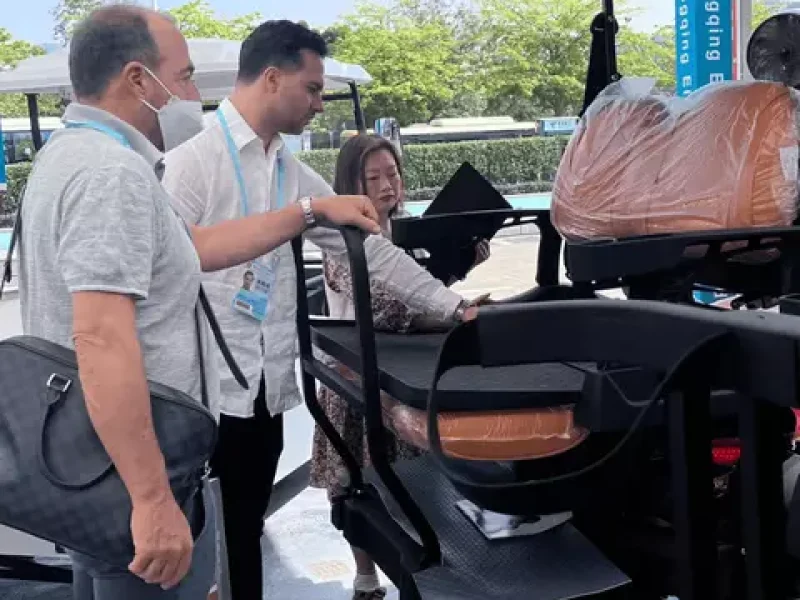
Require the supplier to trial-install rear seats, front-seat brackets, roof supports, windshields, cargo beds, and other shipped accessories on the actual vehicle.
The acceptance condition should be practical: approved parts install using the supplied hardware and documented procedure, without unapproved drilling, slotting, bending, or welding.
Record the trial installation before any transport-related disassembly. Photograph mounting points and label the hardware bags. This directly addresses one of the most frustrating delivery failures: discovering incompatible brackets after unloading.
3. Check the Battery, Charger, and Electrical Installation
Confirm Battery Identity and Compatibility
Compare the installed battery label with the purchase specification. Record its manufacturer, model, serial number, chemistry, nominal voltage, and rated capacity.
For lithium systems, request available battery management system information, including fault status and relevant operating limits. A dashboard showing “100%” does not independently verify battery capacity or usable range.
For lead-acid systems, inspect accessible cases, hold-downs, cables, and terminals for damage, leakage, and corrosion. Electrolyte checks should follow the battery manufacturer’s instructions and apply only to serviceable flooded batteries.
Inspect Connections Safely
A qualified technician should check:
- Battery restraint and protection against movement.
- Cable insulation, routing, and terminal covers.
- Correct cable connections and protective devices.
- Terminal tightening against the battery manufacturer’s specification.
- Signs of overheating, swelling, leakage, or damaged connectors.
Do not apply one universal torque figure to every battery. Terminal designs have different requirements, and both loose connections and overtightening can create serious problems.
Buyers should not open sealed packs, bypass protection systems, or place tools across terminals.
Demonstrate a Complete Charging Cycle
Verify that the charger matches the battery chemistry, system voltage, charging profile, and destination electrical supply.
Ask the supplier to demonstrate charging initiation, normal status indication, completion, and any charging-related drive interlock fitted to the vehicle.
Record charger and battery labels together. Charging should follow manufacturer instructions, including ventilation requirements for lead-acid batteries.
4. Test Every Light, Display, and Accessory
Electrical inspection should be a function-by-function demonstration—not a photograph of an illuminated dashboard.
| Equipment | Practical inspection |
|---|---|
| Headlights | Check every fitted mode and confirm stable operation |
| Brake lights | Confirm activation when the brake is applied |
| Turn indicators | Check each fitted lamp and dashboard indication |
| Horn and reverse warning | Confirm operation where specified |
| Dashboard | Check screen areas, warning symbols, and controls |
| Speedometer | Compare its indication with an independent reference |
| Accessories | Test USB outlets, fans, cameras, and other ordered equipment |
For speed verification, use an appropriate independent measuring method under safe conditions. Agree the acceptable tolerance beforehand rather than inventing one during inspection.
Operate fitted accessories during the functional test and look for flickering, resets, or fault messages. An initial power-on check may miss intermittent problems.
Request an uninterrupted video showing the vehicle identification, dashboard startup, individual functions, and a short drive. Video supplements inspection; it does not replace physical measurements.
5. Inspect Steering, Suspension, Wheels, and Brakes
These checks deserve priority because appearance cannot compensate for unsafe control.
Steering and Wheel Alignment
Check steering movement, abnormal play, binding, tire clearance, and straight-line behavior.
If a front wheel appears misaligned or the vehicle pulls noticeably, require diagnosis before shipment. Possible causes include tire pressure differences, alignment settings, assembly problems, or damaged components.
Do not accept “adjust it after delivery” without a documented cause, repair, and retest.
Wheel fasteners, steering joints, and suspension hardware should be checked against model-specific instructions using suitable tools. Torque marks can help identify movement, but marks alone do not establish correct tightening.
Braking and Parking-Brake Performance
A qualified driver should test braking in a controlled area. The cart should stop predictably without abnormal pulling, grinding, or inconsistent pedal response.
Test the parking brake according to the vehicle manufacturer’s procedure. Any slope test needs an approved location, suitable precautions, and a competent operator.
Universal stopping-distance or hill-holding claims are inappropriate without a defined test method, load, surface, and vehicle specification.
6. Conduct a Controlled Golf Cart Road Test
A brief unloaded drive around the factory may confirm basic movement, but it does not establish suitability for hotel transport, agricultural work, or passenger service.
Use a written road-test plan:
- Record tire pressures, battery state of charge, payload, and conditions.
- Check forward and reverse operation at low speed.
- Confirm smooth acceleration and predictable deceleration.
- Check steering response and straight-line tracking.
- Test service and parking brakes.
- Listen for rattles, rubbing, and abnormal drivetrain noise.
- Review warning indicators and available fault information afterward.
Keep the test within the vehicle’s rated limits. Secure any test ballast and use a controlled route.
Where practical, include representative operating conditions. A resort passenger cart and a cargo vehicle should not be evaluated against identical duty expectations.
A short road test also cannot validate a full-range claim. If range is commercially important, commission a separately agreed endurance test.
7. Use a Three-Gate Inspection for Partially Disassembled Shipments
An especially useful safeguard for export buyers is to inspect the vehicle at three different stages.
Gate One: Complete Assembly
Test the finished cart with every ordered component installed. Capture its identity, configuration, operating functions, and accessory fit.
Gate Two: Transport Preparation
After the functional inspection, document what is removed for shipping. Match each removed item to labeled hardware, installation instructions, and packing-list entries.
Gate Three: Arrival Reassembly
Repeat relevant safety and function checks after unloading and reassembly, before passenger or work use.
This approach separates manufacturing defects from missing packing items, transport damage, and incorrect local installation.
It also creates a clearer evidence trail when buyer and supplier need to determine responsibility.
8. Turn Defects Into a Clear Shipment Decision
A checklist is useful only when failed items have consequences.
The following is a proposed buyer-side classification system. Agree its definitions and release rules in the purchase contract.
| Classification | Example | Proposed action |
|---|---|---|
| Safety-critical | Steering fault, ineffective brake, damaged battery cable | Stop release; repair and retest |
| Major | Inoperative specified headlight, incompatible seat bracket, wrong battery | Correct before shipment |
| Minor | Cosmetic blemish outside the agreed finish standard | Repair or document an agreed concession |
For each defect, record the vehicle serial number, photograph, specification requirement, corrective action, responsible person, and retest result.
For fleet orders, consider requiring documented safety and functional checks on every unit. Cosmetic sampling can supplement this process, but inspecting one display vehicle does not demonstrate the condition of an entire batch.
An independent inspector can provide additional oversight when the buyer cannot attend.
9. Verify Documents, Spare Parts, and Packing
Before release, collect:
- Serial-numbered inspection and test records.
- Operator and maintenance manuals.
- Relevant wiring diagrams and parts information.
- Battery and charger documentation.
- Written warranty terms and claim procedures.
- Replacement-part availability and ordering contacts.
- Photographs of packing, restraints, and supplied accessories.
Clarify warranty exclusions, diagnostic requirements, labor reimbursement, freight responsibility, and response arrangements. “Warranty included” is not a complete support agreement.
For road-use purchases, verify destination-specific vehicle classification, certification, and registration requirements separately. Lights and seat belts alone do not establish legal eligibility for public roads.
Packing should protect the vehicle and loose components against movement and handling damage. Battery transport documentation and packing requirements must be checked for the actual battery and transport arrangement.
Plan Your BorCart Inspection Before You Order
A reliable electric golf cart purchase starts with measurable requirements and ends with recorded acceptance.
When discussing a project with BorCart, share your destination market, operating environment, passenger or cargo needs, preferred battery system, and customization requirements.
Request a quotation accompanied by an agreed specification sheet, accessory-fit checklist, inspection plan, and after-sales terms. For OEM/ODM projects, define prototype approval and shipment-release responsibilities before production begins.

Frequently Asked Questions
1. What is the most important electric golf cart quality check?
Start with safety-related systems: steering, brakes, wheels, suspension, and battery installation. Then verify configuration, component fit, and electrical functions. Cosmetic quality matters, but it cannot offset a safety defect.
2. Can I inspect a golf cart remotely?
Yes, using serial-numbered records, clear photographs, live demonstrations, and uninterrupted videos. However, remote evidence cannot replace every physical measurement. Independent inspection is useful when significant safety or commercial risks remain.
3. Should rear seats be installed before delivery?
They should be trial-installed before transport-related disassembly. Confirm that brackets, mounting holes, fasteners, and instructions match the actual vehicle. Any planned drilling or modification should be explicitly approved in advance.
4. Does a fully charged battery prove good quality?
No. A charge indication does not establish usable capacity, range, or long-term condition. Verify battery identity, installation, charger compatibility, available diagnostic information, and any performance tests agreed in the contract.
5. What should happen if the cart fails inspection?
Document the failure, require corrective action, and repeat the relevant test. Do not release a vehicle with unresolved safety faults. Other exceptions should require explicit written acceptance under the agreed purchase terms.
6. Should I inspect the cart again after arrival?
Yes. Check for transport damage, verify reassembly, and repeat relevant safety and operational checks before use. Pre-shipment approval does not establish that unloading and installation were completed correctly.
References
1. Club Car. “2009–2011 Precedent Golf Car Owner’s Manual,” particularly the pre-operation and daily safety checklist. Supports the discussion of tire condition, electrical connections, steering, and brake checks. Model-specific instructions should not be treated as specifications for every cart. https://jerrypate.com/wp-content/uploads/2018/01/Precedent_Owners-Manual_2009-2011.pdf
2. Trojan Battery Company. “Battery Maintenance.” Supports battery-case inspection, cable condition, terminal-specific torque requirements, charger instructions, and lead-acid charging precautions. https://www.trojanbattery.com/resources/battery-maintenance
3. Trojan Battery Company. “Lithium Battery Resources & FAQs.” Supports the need to follow battery-specific installation precautions, operating limits, and charging requirements rather than applying universal lithium-battery settings. https://www.trojanbattery.com/technology/trojan-lithium-batteries/lithium-ion-battery-resources
4. National Highway Traffic Safety Administration. “Interpretation ID: Zozloski_1635.” Explains the regulatory distinction between conventional golf carts and regulated low-speed vehicles. Buyers should verify current requirements for their destination and intended use. https://www.nhtsa.gov/interpretations/zozloski1635
5. Customer-provided review screenshot. Used only to identify reported buyer frustrations involving electrical functions, component fit, wheel alignment, and replacement-part support. These allegations were not independently verified. https://ppl-ai-file-upload.s3.amazonaws.com/web/direct-files/attachments/images/41925145/d51e1f57-515c-473e-9d25-d1fe7eb9dd7a/Tu-Pian.jpg
Hot Tags: Electric Golf Cart, Golf Cart Manufacturer, Electric Golf Cart Supplier, Wholesale Golf Carts, OEM Golf Carts, ODM Golf Carts, Custom Golf Carts, Commercial Golf Carts, Golf Cart Quality Inspection, Golf Cart Pre-Delivery Inspection